Our own Micki and John Morahn’s Debs research was covered in a recent issue of the Terre Haute Tribune Star:
“Morahn retold that story and others last month, building a case for a more realistic picture of Kate, wife of the Terre Haute-born activist whose exploits earned him a spot on Life Magazine’s list of the 20th Century’s Most Influential Americans nearly 75 years after his death. Morahn saw the lack of an in-depth study of Mrs. Debs as a void in the otherwise voluminous history of Mr. Debs. So, four years ago, Morahn and her husband, John, began compiling biographical information about Kate.”
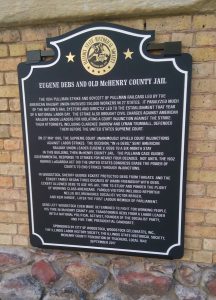
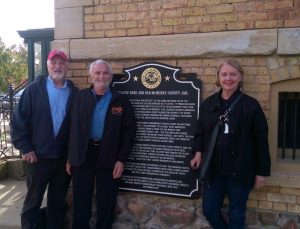
In 1895, following the conclusion of the Pullman Railroad Strike, Eugene Debs served a six months term in the McHenry County Jail located in Woodstock, Illinois. On Saturday, October 21, 2017, a plaque which memorializes the significance of the imprisonment and its impact on the labor movement and the free speech movement in the decades that followed was unveiled at the site of that jail. An enthusiastic group of local citizens and guests from around the MIdwest attended two forums that discussed the strike and its aftermath from a number of perspectives. Representing the Debs Foundation were Dave Rathke, Laurie Beasley and Noel Beasley.
In spite of all the efforts to keep Debs out of history books and popular culture, there continue to be important victories such as has been achieved in Woodstock. A group of local teachers, historians, attorneys and other community activists created Woodstock Celebrates, Inc. to insure the celebration of the town’s local history and then conducted a multi-year campaign to raise funds and secure the placement of the plaque at the Old County Jail. The forums provided excellent opportunities for exchanges of facts and opinions of past events and also on the struggles of workers and progressives in 2017.
A number of the participants in those events have been inspired to focus next on the placement of a plaque in the town of Pullman, Illinois. A short drive south from Chicago’s Loop, Pullman celebrates the noblesse oblige of the Pullman family by conducting tours of the “model company town” that rival a Disney theme park in fantasizing a past that never existed. There is a conscious avoidance of any mention of the strike, the beatings and murders of strikers and the role of the federal government in crushing the strike and sentencing Debs to prison. A struggle to create a monument to Debs and the workers of Pullman will be difficult given the corruption and chaos now rampant in the Illinois state government let alone the hostility of the Trump Fake Department of Labor to unions. But it is battles like this that provide a critically important opportunity to remind everyone of the “other history” of our country.
Check out this special edition of On Contact: Chris Hedges travels to the former auto manufacturing town of Anderson, Indiana to explore how a community and its workforce are recovering after the loss of thousands of union jobs.
Featuring Eugene V. Debs Museum director Allison Duerk, and board member Denny Cheshier!
The Eugene V. Debs is pleased to announce that Tim Kelley, one of our board of directors, has agreed to lead a walking tour of Eugene V. Debs landmarks and locations of historical interest in the Terre Haute area during the weekend of our annual awards banquet. The tour will run from approximately 1pm until 3pm on Saturday, October 14th.
If you would like to reserve a space on the walking tour for yourself and your companions, please complete this registration form and we will add you to the list. We ask for a voluntary donation of $5 per person to cover the cost of van or bus rental.
Looking forward to seeing you there,
The Board and Officers of the Eugene V. Debs Foundation
A supporter tipped us off to this recent piece about the museum late last week. Thanks to James Glass and the Indianapolis Star for this piece on Debs: The first Bernie Sanders — Indiana’s Eugene V. Debs.
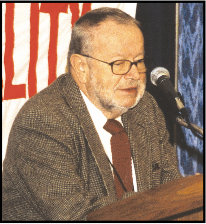
The Eugene V. Debs Foundation is saddened to report the passing of Professor J. Robert Constantine, the last surviving founder of the Eugene V. Debs Foundation, who passed away at his home in Austin, Texas, on Thursday, May 25, 2017, at the age of 93. In 1962, he was the member of a small group who raised money and negotiated the purchase of the Debs Home from a local developer, thus saving the home from the wrecking ball. Bob served as Foundation Secretary from 1962 until 1983 and was a long time professor of American History at Indiana State University, retiring in 1989.
Professor Constantine edited the 3 volume “Letters of Eugene V. Debs”, published by the University of Illinois Press in 1990, and prepared an abridged 1 volume edition, “Gentle Rebel” that was released in 1995. He was also the author of numerous articles.
In his role as a founder and the organization’s first secretary, Bob worked tirelessly to restore and preserve the Debs Home, raised funds and built up the foundation’s membership. For more than 20 years, he organized Debs Award dinners, handled the groups correspondence as well as completing numerous administrative functions and doing this all without a salary!
Ben Hanford, the 1904 & 1908 Socialist Party Vice Presidential nominee created a fictional character known as “Jimmie Higgins”. It was “Jimmie” that performed the silent, unglamorous, behind the scenes work that allowed the party to achieve its success. Bob Constantine was a scholar, a friend and through his tireless efforts for the Eugene V. Debs Foundation, he was our “Jimmie Higgins”!
Thank you Bob and rest in peace.
— Tim Kelley
The home and museum dedicated to the memory of Terre Haute’s own Eugene V. Debs (1855-1926) stands in the heart of Indiana State University. I remember the home, when it housed the Theta Chi Fraternity. It is amazing that the beautiful oak woodwork and glassed enclosed bookcases, which frame the fireplace in the parlor are so well-preserved, surviving fraternity party life.
A few days ago, I decided to visit the Debs home after learning that my favorite professor from my ISU years, Dr. J. Robert Constantine, had passed away at 93 in his home in Austin, TX on May 25, 2017. Dr. Constantine taught history; I had him for numerous undergraduate and graduate course, since I majored in history and have my Master’s in American history.
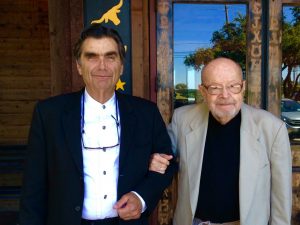
Jed Smock (left) with Bob Constantine
Dr. Constantine retired from ISU in 1989. For a number of years, I lost track of him when he moved to College Station, TX. However, in the late nineties we reconnected, when I visited him during one of my preaching engagements at Texas A&M. I was pleased that he was interested enough in my mission that he came out to campus to listen for about an hour. This began an annual visit with the professor, which continued after he moved to Austin; there we had dinner together whenever I was speaking at UT.
Dr. Constantine was the foremost Debs scholar and was the last living founder of the Debs Foundation, which owns the Debs home and museum. I concluded that a visit to the Debs Memorial was a fitting tribute to my late friend and old mentor.
One of the bedrooms is dedicated to James Whitcomb Riley; it contains Riley memorabilia, including poems of Riley and correspondence between Riley and Debs, carefully preserved. Riley stayed in the Debs’ home, when visiting Terre Haute.
I asked my knowledgeable tour guide about the friendship between the sentimentalist Hoosier Poet, Riley and America’s most renown socialist, Debs. She said, Debs had the ability to “forge friendships” with people with other points of view.
On the top floor, the walls are covered with murals painted by Terre Haute artist, the late John Laska, which depicts leading progressives, socialists and communists, including Karl Marx. However, in the midst of the pictures is a dignified portrait of Terre Haute’s leading industrialist and philanthropist, Herman Hulman. Below the portrait is a plaque which reads, HERMAN HULMAN MEMORIAL AUDITORIUM The Gift of His Grandson, Anton Hulman, Jr. 1975.
I said to my tour guide, “Isn’t it ironic that the Hulman family, Terre Haute’s most notable capitalists, contributed the money to finance this auditorium with these impressive murals of radicals?” She reminded me that Debs in his twenties had worked for Herman Hulman’s wholesale grocery house for five years. Then again, she reiterated how Debs had a talent for “forging friendships” with men with whom he had political differences and that his views became more radical with the passing of his years. However, there was a mutual respect between Hulman and Debs, until Hulman’s passing in 1913.
Earlier during the tour, I had remarked that Dr. Constantine did not admire President Wilson, who had Debs imprisoned for opposing the draft in WWI; he was found guilty of sedition. It was a Republican president, Harding, who commuted Debs’ sentence, which Wilson refused more than once. After Debs’ release, Harding invited Debs to the White House upon receiving him, he said, “Well, I’ve heard so damned much about you, Mr. Debs, that I am now glad to meet you personally.” Debs was not a sour socialist; he had a warm charismatic personality. Evidently, Harding respected Debs for his willingness to go to prison for his convictions. During his imprisonment, Debs made one of his five runs for the presidency on the Socialist Ticket.
Even though Dr. Constantine and I were at different ends on the political spectrum, we always were able to enjoy one another’s company in our dinner conversation. Sometimes after the passing of his wife instead of going out, he would fix me a sandwich in his home. Dr. Constantine said more than once, “Jed and I don’t agree on a lot of things but that does not make any difference.” I was proud that he would say that I was the best student he ever had, sometimes he would qualify that and say, “one of the best.” He once said that he admired “my moxy” for standing up for what I believed.
We talked some politics and history but mostly about Terre Haute, ISU and mutual friends and acquaintances. When I turned 70, he remarked, “You know you are getting old, when one of your students is 70.” He was 89 then. He said to me, “Call me Bob.” But I never felt comfortable being so familiar, so I addressed him as “Doctor.” I usually would bring up the saving grace of Christ at some point in our conversations; he listened patiently for he was not a particularly religious man; nevertheless, he was a kind man and always a gentleman. Although he was raised a Catholic, he was not practicing. He always allowed me to say grace over our meals and sometimes I would even conclude our visits in prayer.
Dr. Constantine in our correspondence referred to me as “old friend.” At my last call to my old friend this past winter, I had my wife, Cindy, with me. The last few years he was in assisted living so we would just visit in his room. His short-term memory was not so good by now but long-term memory was still intact. He always recognized me and my wife. My last picture of him is concluding our visit with prayer. As we all bowed our heads, my wife and I recited the Lord’s prayer, he repeated it with us.
The Mr. Hulman, and Mr. Riley connections with Mr. Debs set a good example, that men should not allow different politics from hindering a friendship. Friendship should trump politics.
In the Riley bedroom at the Debs home is a handwritten original manuscript of one of Riley poems, which he dedicated to Debs, entitled “Them Flowers.”
“So here, all alone with the roses you send–
Bein’ sick and all trimbly and faint,–
My eyes is–my eyes is–my eyes is–old friend–
Is a-leakin’–I’m blamed ef they ain’t!”
When I walked into the Deb’s memorial, I had to hold back my eyes from a-leakin’ over the passing of my old friend, Dr. Constantine. Yet, I was encouraged by the visit to this interesting and appropriate Terre Haute historical sight.
— George “Jed” Smock
[ We at the Debs Foundation are aware that George Smock has been and continues to be a controversial figure in the Terre Haute area, but as his remarks about Bob Constantine were respectful and sincere, we thought it would be appropriate to include them. ]
The Eugene V. Debs Foundation Gratefully Acknowledges Donations Made in Memory of Dr. J. Robert Constantine by
Aaron Chappell The Doritys Laurie Jaeger and Bill Wigle Ann and Kim Kizer Darwin Hamilton Stephen Howard Tim Kelley John Kite Melissa and George Libal John Nation Gail Malmgreen Christopher Rickerd Ron and Jan Schlattmann Ann Seltzer Silky Shah Suzanne VanReed Forrest Wilder The Officers of the Eugene V. Debs Foundation
2017 Eugene V. Debs Award Recipient Jobs with Justice
On Saturday, October 14, 2017, the Eugene V. Debs Award will be presented to the Jobs with Justice national organization together with its regional and local affiliates. Sarita Gupta, the Executive Director of Jobs with Justice, will accept the Award. The event will begin at 6:00PM with a cocktail hour followed by dinner and the Award presentation at 7:00PM. The location will be the Sycamore Banquet Facility on the campus of Indiana State University, Terre Haute, Indiana.
For more than thirty years Jobs with Justice has led the way in building broad based coalitions fighting with discipline and effectiveness for the rights of working people. It is a timely and appropriate award presentation given the tide of resistance swelling across our country to counter and overcome the ferocious offensive being conducted by Trump Inc. It has never been more important to emphasize that organizations and networks such as Jobs with Justice are essential driving engines of social change and to acknowledge the roles that they play in uniting leaders in common causes.
Nearly a century after his death, American trade union and socialist leader Eugene V. Debs will be the subject of a major new publishing initiative. Eugene V. Debs: Selected Works is the working title for a four volume series to be published by Chicago publisher Haymarket Books, one of the leading publishers of socialist books in the United States during the 21st Century.
Heading the project is Tim Davenport, 55, a self-described “grumpy old Left Social Democrat” whose previously served as co-editor of a nearly 700-page compilation of documents produced from 1929 to 1940 by dissident American Communist Jay Lovestone and his political associates, published in 2015 by the Dutch academic publisher Brill.
“I consider Gene Debs to be one of my personal heroes,” Davenport said. “He was a man of even temperament and humane vision that dedicated his life to building a better world through creation of a more democratic and just economic system. Debs never shirked his duty, he stood up against corporate greed and militarism and did his best to build a political movement to halt this country’s slide into financial corruption, exploitation of labor, and war. He was a consistent exponent of human rights, including freedom for the particularly targeted populations of women and black Americans. Debs was not afraid to go toe-to-toe with state power, and he followed the course of his beliefs without hesitation or fear.”
Davenport notes that although there are several short assemblages of Debs writings on the market, only a microscopic fraction of the Indiana socialist’s writings have seen print in recent decades.
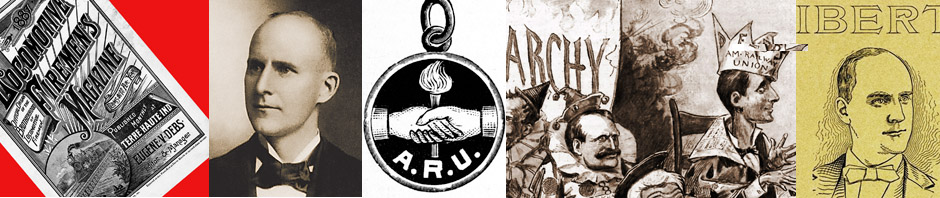
Debs-Related Imagery from the Project Site
“Almost everything is traceable to two sources — a 1908 campaign collection of a few dozen articles and speeches, thinly supplemented by a 1948 expanded edition,” Davenport said. “There has never been anything remotely resembling a scientific accumulation of his work, outside of the outstanding three volume selection of letters assembled in the 1990s by Bob Constantine. Between articles that Gene Debs wrote and speeches that he delivered which were reported at least in part in a verbatim fashion, there are somewhat more than 4,000 items in the world — not touching a single letter. Of these, barely more than 100 have ever been reprinted. More than 95% of this iceberg remains underwater, hidden from view. It is an honor and a privilege to be in a position to identify and republish the best of this largely unknown material for this and future generations.”
Joining Davenport as co-editor in this privately-funded initiative is David Walters of Pacifica, California, librarian at the Holt Labor Library, a small, private institution in San Francisco with a focus on the literature of trade unionism and left wing activism. In addition, Walters is a member of the Board of Directors of Marxists Internet Archive (MIA) and coordinator of that group’s “Eugene V. Debs Internet Archive,” the largest online assemblage of Debs writings in the world.
The Debs Selected Works project will consist of four volumes, each approximately 700 pages in length, to be released at the rate of one per year beginning in 2018. Volume 1 will be entitled Railway Populist, 1877-1896 and will include republication for the first time of a healthy selection of articles prepared by Debs during the decade he served as editor of Locomotive Firemen’s Magazine.
“Debs was a well-read and insightful commentator on the American labor and political situation,” Davenport said. “While he started out as a conservative advocate of sobriety and duty to one’s employers, over time he evolved into a rather entertaining critic of the particularly noxious economic monopolies that marred the American landscape during the 1880s and 1890s. He gradually grew disaffected with the way that unified corporate power bullied and dominated disunited craft groups like the Brotherhood of Locomotive Firemen and emerged as a pioneering advocate of labor federation and later industrial unionism.”
The first volume of the Debs Selected Works will deal largely with the relations between organized capital and organized labor during the decade of the 1890s, culminating with the great 1894 Pullman Strike which tangled the American transportation system and ultimately led to Debs’ jailing for six months without trial on charges of “contempt of court.”
“Debs’ role in the Pullman boycott as head of the American Railway Union (ARU) is well known,” said Davenport. “What remains largely unknown are efforts before the Pullman strike to build a federation of the various semi-rival railway brotherhoods for joint action for better wages and conditions. Nor is his activism for the People’s Party in after his six month jail term in 1895 until the loss by William Jennings Bryan in the election of 1896 appreciated by more than a handful of scholars. This book will make those pages of history readily accessible as Debs tells the story in his own provocative and inspirational style.”
Davenport notes that the Railway Populist, 1877-1896 volume will include approximately 150 Debs articles, speeches, and open letters and will be organized chronologically. Almost all will be pieces republished for the first time.
A website has been launched to provide weekly updates on the development of the Debs Project, to be found at https://debsproject.org/
Davenport invites contact by interested scholars and individuals, with his email address to be found at the website mentioned above.